Agriculture Ecosystem Case Study
Making Food Self-Sufficiency a Reality Through Technology-Driven Infrastructure
A case study by TFB Network. Home Garden, Agro Point, and Container Farm: three infrastructure projects deployed from household to urban scale, making Kerala's food chain self-sufficient, stable, and attainable.
14
Districts Targeted
1,178 T
Daily Vegetable Deficit
90%
Less Water Usage
35x
More Yield Per Acre
40%
Produce Lost Before Market

Executive Summary
Kerala requires 5,479 tonnes of vegetables every single day. It produces only 4,301 tonnes locally. The remaining 1,178 tonnes arrive daily in trucks from Tamil Nadu and Karnataka, often carrying pesticide residues measured at three to five times above permissible limits. In 2023-24, against a total annual demand of 20 to 21 lakh metric tonnes, the state produced 17.21 lakh tonnes, leaving a deficit of nearly 4 to 5 lakh metric tonnes. Eight years ago, this deficit was 14 lakh tonnes. Progress has been made, but self-sufficiency remains a shifting goalpost, reinvented with each passing government scheme.
TFB Network is building the infrastructure to close this gap permanently. Not through more subsidies or cultivation campaigns, but through three purpose-built production infrastructure projects that operate independently of weather, season, soil quality, and interstate supply chains. Home Garden: a smart polyhouse inside every home, producing 50%+ of a family's vegetable needs from 100 to 400 sqft for Rs 50,000 to Rs 1,00,000. Agro Point: 140 commercial polyhouse operations from 3,000 to 1,00,000 sqft across every assembly constituency, producing leafy vegetables and out-of-season crops year-round. Container Farm: 30x yield multiplication in dense urban areas where land is scarce but demand is highest. Together with a complete farm-to-table distribution network, these three projects make self-sufficiency an infrastructure, not an aspiration.
The Problem
A State That Imports What It Should Grow
Kerala has the climate, the water, the talent, and the consumer demand. What it lacks is the production infrastructure to meet that demand locally, safely, and consistently.
1,178 Tonnes Imported Daily
Kerala's daily vegetable requirement is 5,479 tonnes. Local production covers 4,301 tonnes. The remaining 1,178 tonnes arrive every day from neighboring states, primarily Tamil Nadu and Karnataka. Onions, tomatoes, potatoes, beans, carrots, cabbage, and cauliflower are the primary imports.
Pesticide Contamination at 3-5x Permissible Levels
Kerala's Food Safety Commissioner formally wrote to Tamil Nadu in 2015 after Kerala Agricultural University analysis found pesticide residues three to five times above FSSAI permissible limits in imported vegetables. The state has repeatedly considered banning vegetable imports due to contamination, but cannot because it has no alternative local supply at sufficient scale.
Weather-Dependent, Flood-Vulnerable Production
The 2018 Kerala floods caused economic losses estimated at Rs 27,000 to Rs 40,000 crore. 26,106 hectares of rice paddy were destroyed. The plantation industry lost up to 40% of current crops. 5.4 million people were affected across 1,259 out of 1,664 villages. Agriculture bore 88% of total damage. Traditional open-field farming offers zero protection against such events.
25-30% Post-Harvest Losses
India loses an estimated 25 to 30% of its annual agricultural output to post-harvest waste: 4 to 8% during harvesting, 5 to 8.5% in transportation, 3.5 to 5.7% in storage, and 5 to 15% at retail. The NABCONS study (2020-22) found tomato losses at 11.62% and guava at 15.05%. Nationally, horticulture losses amount to 49.9 million metric tonnes annually.
99% Gap in Pack-Houses, 85% Gap in Reefer Vehicles
According to the National Centre for Cold-chain Development, India's gap in cold storage infrastructure was only 8% in 2020, but the gap in pack-houses was 99%, in reefer vehicles 85%, and in ripening chambers 91%. The bottleneck is not storage alone. It is the entire cold chain from farm gate to consumer.
Shrinking Agricultural Land
Kerala's vegetable cultivation area peaked at 1,49,054 hectares in 2012 and fell to 88,155 hectares by 2020 before recovering to 1,02,484 hectares by 2025. With a population density of 860 per square kilometer and only 8% of GSDP from the primary sector, horizontal expansion of farmland is not viable. 80% of Kerala's traditional paddy fields have been converted to rubber plantations or leveled for construction.
Rs 92,000 Crore of Food Wasted Annually
India wastes approximately 67 million tonnes of food annually, worth an estimated Rs 92,000 crore. 68.7 million tonnes of food is wasted in Indian households alone, roughly 55 kg per person per year. India ranks 105th out of 127 countries on the Global Hunger Index while simultaneously being one of the world's largest food producers. The FAO estimates that up to 40% of India's fruits and vegetables are lost before reaching the market.
Youth Exodus from Agriculture
Less than 8% of Kerala's GSDP comes from agriculture. Kerala's agricultural growth rate in 2024-25 was 4.65%, outpacing the national average of 2.1%, but the sector lacks the technology, infrastructure, and income potential to retain educated youth. The 96% literacy rate that produces engineers and IT professionals is the same rate that drives talent away from farming. Without technology-driven infrastructure, agriculture cannot compete with services for the next generation's attention.
The Big Picture
The World Must Produce 70% More Food by 2050
Kerala's food deficit is a local symptom of a global crisis. The solutions must match the scale of the problem.
10B
World Population by 2050
70%
More Food Needed
735M
Facing Chronic Hunger
1.3B MT
Food Lost/Wasted Yearly
Global Food Crisis
The world produces nearly 10 billion tonnes of crops annually, double the output of 1960. Yet 735 million people faced chronic hunger in 2023. One-third of all food produced globally is lost or wasted, enough to feed 3 billion people. The issue is not just production. It is distribution, infrastructure, waste, climate shocks, and affordability. By 2050, the world will need to produce 70% more food to sustain a population nearing 10 billion, while climate change threatens to reduce crop yields by 20 to 47% in key staples.
India's Paradox
India is the world's second-largest producer of fruits and vegetables, yet loses 40% before it reaches consumers. India ranks first globally in milk production, second in dry fruits, third in fish, fourth in eggs, and fifth in poultry. Agriculture production grew from $87 billion to $397 billion in 14 years. But 224 million Indians remain moderately or severely food insecure, and 35.5% of children under five experience stunted growth. India ranks 105th on the Global Hunger Index. The problem is not production capacity. It is infrastructure between the farm and the plate.
The Controlled-Environment Revolution
A single 40-foot container farm produces as much food as an acre of traditional farmland using 90% less water. One acre of vertical farming can match 10 to 35 acres of conventional farming. Dubai's largest vertical farm produces over one million kilograms of leafy greens annually, saving 250 million liters of water. AeroFarms in Newark produces 2 million pounds of produce per year in 70,000 square feet. The technology is proven, scalable, and deployable today.
The Solution
Three Projects That Cover Every Scale of Production
Not more cultivation campaigns. Three purpose-built production infrastructure projects, from a 100 sqft home unit to a 1,00,000 sqft commercial operation, that make self-sufficiency structural, weather-independent, and permanent.
| Project | Scale | Space | Deployment Level | Target |
|---|---|---|---|---|
| Home Garden | Household | 100-400 sqft | Every home in Kerala | 50%+ of family vegetable needs |
| Agro Point | Commercial | 3,000-1,00,000 sqft | Every Assembly Constituency | 140 facilities for year-round commercial production |
| Container Farm | Urban/Dense Areas | 40-ft container clusters | Urban centers | 30x yield in minimal footprint |

Home Garden: A Smart Polyhouse Inside Every Home
Every Household in Kerala
Home Garden is a fully autonomous smart polyhouse system designed for residential installation, occupying as little as 100 square feet and scaling up to 400 square feet. Priced between Rs 50,000 and Rs 1,00,000, it is engineered to generate above 50% of a family's vegetable requirements from their own terrace, backyard, or rooftop. This is not a hobby garden kit. It is a production-grade, climate-controlled growing system that runs itself.
Square Feet
100-400
Investment
Rs 50K-1L
Plants
300-1,500
Family Needs Met
50%+
Key Features
300 to 1,500 Plants at a Time
Depending on the configuration (100 to 400 sqft), Home Garden supports 300 to 1,500 plants growing simultaneously. Multiple crop varieties can be cultivated in parallel: leafy greens, herbs, tomatoes, peppers, cucumbers, and more. The system is designed for continuous harvest, not single-season planting.
Fully Autonomous Operation
Smart irrigation, automated nutrient delivery, and climate control sensors manage the entire growing process without daily human intervention. The system waters, feeds, and monitors crops automatically. IoT sensors track temperature, humidity, light levels, and nutrient concentrations in real time. Alerts notify the homeowner only when attention is needed.
Above 50% of Family Vegetable Requirements
A mid-sized 200 sqft Home Garden producing 600 to 800 plants continuously can supply more than half of a typical Kerala family's daily vegetable consumption. This directly reduces dependence on market-purchased vegetables, many of which arrive from Tamil Nadu and Karnataka with documented pesticide contamination at 3 to 5x permissible levels.
Zero Pesticides, Maximum Freshness
Enclosed polyhouse environment prevents pest entry. No pesticides, no chemical residues, no contamination risk. Harvest-to-plate distance: zero. The freshest possible produce, grown in the same space where it is consumed.
Affordable at Rs 50,000 to Rs 1,00,000
A one-time investment that pays for itself through reduced monthly vegetable purchases. A Kerala family spending Rs 2,000 to Rs 4,000 per month on vegetables recovers the investment within 12 to 24 months while eating fresher, safer, pesticide-free produce.
The Path to a Fully Self-Sustaining Kerala
If implemented across Kerala's approximately 85 lakh households, Home Garden would structurally eliminate the state's vegetable deficit at the most granular level possible: the individual family. 222,312 backyard farms already operate in Kottayam district alone. The demand is proven. The technology makes it scalable.
Agro Point: Commercial Polyhouse Infrastructure for Year-Round Production
Every Assembly Constituency (140 Facilities)
Agro Point is a commercial-scale polyhouse operation ranging from 3,000 square feet to 1,00,000 square feet. It is built to produce leafy vegetables, seasonal fruits, and crops that are either unavailable in Kerala's natural climate or not available in all seasons. Controlled weather systems, autonomous growing technology, and continuous monitoring enable significantly higher yields at lower operational costs than open-field farming. This is the production backbone that bridges the gap between household-level Home Gardens and the hyperlocal density of Container Farms.
Target Facilities
140
Square Feet Each
3K-1L
Production
365 Days
Deployment
Every AC
Key Features
Controlled Weather, Zero Climate Risk
Temperature, humidity, ventilation, and light are precisely managed inside the polyhouse. The 2018 Kerala floods destroyed 26,106 hectares of rice paddy and 40% of plantation crops. Agro Point facilities are structurally immune to monsoons, floods, droughts, and extreme weather. Production continues uninterrupted regardless of what happens outside.
Autonomous Systems with Continuous Monitoring
IoT sensor networks track every environmental parameter in real time. Automated irrigation delivers exact water and nutrient quantities to each plant. Climate control systems adjust temperature and humidity without human intervention. Remote monitoring dashboards allow operators to manage facilities from anywhere.
Higher Yield, Lower Cost
Controlled-environment polyhouse farming produces significantly more per square foot than open-field cultivation. Water consumption drops by 70 to 90%. Crop cycles accelerate because growing conditions are optimized 24/7. Post-harvest losses (estimated at 25 to 30% nationally for vegetables) are virtually eliminated because production and distribution are co-located.
Scalable from 3,000 to 1,00,000 sqft
Agro Point is modular. A small-town operation can start at 3,000 sqft and expand as demand grows. A district-level commercial farm can deploy 50,000 to 1,00,000 sqft for wholesale production. The same technology and operational model scales linearly.
Supply for Retail, HoReCa, and B2B
Agro Point output feeds directly into the distribution network: branded retail outlets, hotel and restaurant supply contracts, hospital and school cafeteria agreements, and wholesale aggregation. Long-term supply contracts give operators income predictability. Premium positioning commands higher margins than commodity vegetable trading.
What Agro Point Produces
Leafy Vegetables at Scale
Lettuce varieties, spinach, kale, arugula, pak choi, microgreens, and specialty salad greens that command premium prices in retail and HoReCa markets.
Seasonal Fruits and Vegetables Year-Round
Tomatoes, capsicum, bell peppers, strawberries, exotic herbs, cherry tomatoes, zucchini, broccoli, and other crops that Kerala's open-field climate cannot reliably produce year-round.
Crops Not Native to Kerala's Climate
Temperature-sensitive varieties that thrive in cooler or drier climates but cannot survive Kerala's humidity and monsoon patterns in open fields.
Floriculture: A High-Value Opportunity
- India accounts for approximately 15% of the global market for traditional loose flowers
- In November-December 2024, India hosted 4.8 million weddings generating Rs 6 lakh crore in business
- Estimated Rs 15,000 to Rs 40,000 crore in flower demand in a single 35-day wedding window
- Over 8 million tonnes of flowers discarded annually into rivers for religious purposes across South Asia
Demand is booming from urban landscaping, the wedding and event industry, religious and cultural use, and e-commerce flower delivery. A distributed floriculture network with micro-sites on schools, colleges, and local land can capture anchor crop windows: Onam (August to September), Vishu (April), and the November to February wedding season.
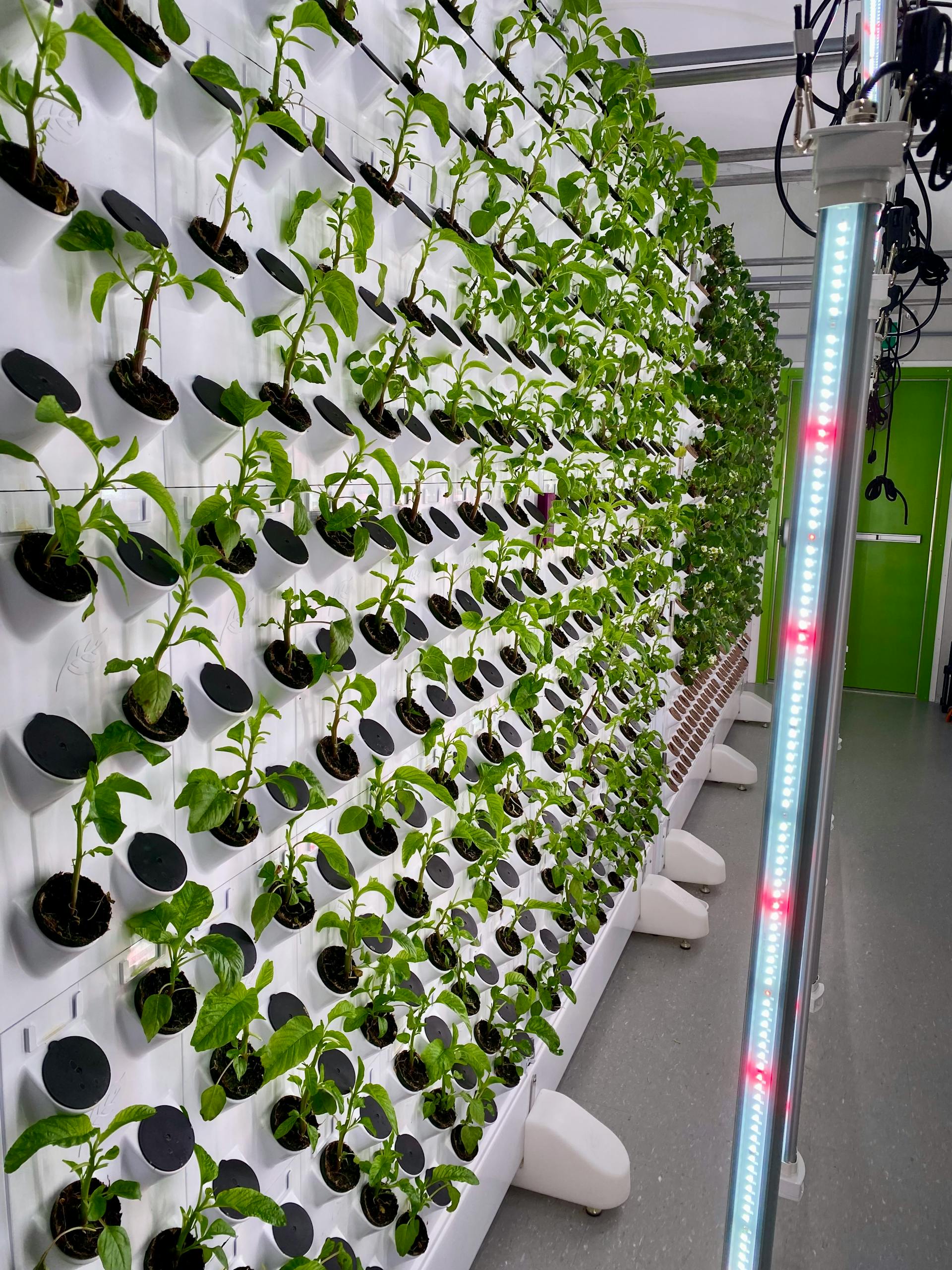
Container Farm: 30x Production in Urban Areas with Zero Space to Spare
Urban Centers with High Density and Limited Land
In urban areas where population density is high and available land is scarce, traditional farming and even standard polyhouses cannot operate. Container Farms solve this by converting standard 40-foot shipping containers into fully climate-controlled vertical growing environments. They take less space, use less water, require fewer resources, and produce 30x more crops than the same footprint of open-field agriculture.
Container Size
40 ft
Yield Multiplier
30x
Water Savings
90-95%
Production
365 Days
Vertical Hydroponics Inside Shipping Containers
Standard 40-foot shipping containers are converted into sealed, climate-controlled growing chambers. Vertical hydroponic racks stack crops in multiple layers, multiplying productive area per square foot. LED lighting tuned to each crop's photosynthetic needs replaces sunlight entirely. Automated nutrient delivery systems feed plants with precision. A single container can produce as much food as 1 to 2.5 acres of traditional farmland.
90-95% Less Water Through Closed-Loop Systems
Hydroponic systems recirculate water through sealed loops, recapturing evaporation and runoff. Traditional open-field irrigation can consume 500 to 1,000 liters to produce a single kilogram of tomatoes. Container Farms operate on a fraction of that. In urban areas where water supply is metered and expensive, this is not just environmentally responsible. It is economically essential.
30x Yield Multiplication in Minimal Footprint
The combination of vertical stacking, optimized LED lighting, accelerated crop cycles, and precision nutrient delivery produces roughly 30 times more crops per square foot than conventional open-field agriculture. For urban municipalities where every square meter is contested between housing, commercial, and public use, Container Farms extract maximum food production from minimum space.
Zero Pesticides, Zero Contamination
Sealed environments prevent pest entry. No soil means no soil-borne disease. No chemical intervention required at any stage. Produce is pesticide-free by design, not by certification. This directly addresses Kerala's documented problem of imported vegetables carrying pesticide residues at 3 to 5x permissible FSSAI limits.
Deployable Anywhere, Stackable for Density
Container Farms can be deployed on parking lots, rooftops, vacant urban plots, industrial zones, or any flat surface with access to water and electricity. No fertile soil required. No land clearing. Containers can be stacked vertically to further multiply production per unit of ground area. A cluster of 20 containers on half an acre can feed a significant portion of an urban ward.
Ideal for Kerala's Dense Urban Corridors
Kerala's population density of 860 per square kilometer makes it one of India's most densely populated states. Cities like Kochi, Thiruvananthapuram, and Kozhikode have limited undeveloped land for conventional agriculture. Container Farms are purpose-built for exactly this constraint: maximum food production from minimum land, deployed within the urban area itself.
The Deployment
Three Projects, Three Scales, Complete Coverage
From the kitchen terrace to the urban core, every scale of food production is addressed.
| Project | Scale | Deployment Level | Purpose |
|---|---|---|---|
| Home Garden | 100-400 sqft, Rs 50K-1L | Every household (85 lakh+ homes) | 50%+ of family vegetable needs |
| Agro Point | 3,000-1,00,000 sqft | Every Assembly Constituency (140) | Commercial production, floriculture |
| Container Farm | 40-ft container clusters | Urban centers | 30x yield in dense areas |
| Distribution | Retail + B2B + App | State-wide | Farm-to-table within hours |
Household
A family installs a 200 sqft Home Garden on their terrace for Rs 75,000. 600 plants grow simultaneously. Above 50% of vegetable needs met. Investment recovered in 12 to 18 months.
Town/District
One of 140 Agro Point facilities operates in each assembly constituency, producing year-round for the local market. 20 to 30 direct jobs per facility.
Urban
A cluster of 15 containers on a quarter-acre plot in Kochi produces fresh vegetables for the surrounding 5 km radius. 30x yield. Zero food miles.
Farm to Table
Closing the Last Mile: Harvest to Home in Hours
India's cold chain gap is 99% in pack-houses and 85% in reefer vehicles. The answer is not more cold storage. It is eliminating the distance between production and consumption entirely.
Fresh Produce Retail Outlets
Physical retail locations in urban centers serving as one-stop destinations for fresh, locally grown vegetables, fruits, flowers, and value-added products like salad kits. Marketplace for crops produced across the entire container farm and polyhouse network. Direct supply from production infrastructure ensures freshness within hours of harvest.
B2B and Wholesale Supply
End-to-end supply solutions for large-scale buyers. Bulk supply to retailers, restaurants, hotels, hospitals, schools, and corporate cafeterias. Long-term contracts that provide farmers with income predictability instead of dependence on volatile mandi pricing. Remote monitoring technology subscriptions for institutional buyers.
AI-Powered Nutrition and Wellness
An AI-powered nutrition coach that continuously tracks individual health profiles to create dynamic, personalized diet plans. Custom salad and meal plans designed by nutritionists for specific needs: stroke recovery, pregnancy, diabetes management, weight loss. Monthly subscription plans for gyms, hospitals, schools, and corporates.
The Difference
What Makes This Different From a Government Agriculture Scheme
Kerala has announced self-sufficiency targets in 2016, 2020, 2024, and again in 2025. Each time the goalpost moves. Schemes expire with budgets. Infrastructure creates permanent capacity.
Production Infrastructure, Not Subsidies
Government schemes provide subsidies for seeds, fertilizers, and equipment. Nine years of self-sufficiency schemes have moved Kerala from 40% to 78% local production, but the remaining gap persists because the underlying production model has not changed. This ecosystem builds the production infrastructure itself: container farms, polyhouses, and distribution networks that produce food 365 days a year.
Controlled Environment, Not Open Field
Traditional farming lost 26,106 hectares of paddy in the 2018 floods alone. Container farms and polyhouses are sealed, climate-controlled systems immune to monsoons, droughts, pest infestations, and extreme weather events. Production is decoupled from every external variable that makes traditional farming unpredictable.
90-95% Less Water
Kerala receives 3,000mm of annual rainfall but still faces agricultural water stress during dry months. Open-field irrigation can consume 500 to 1,000 liters to produce a single kilogram of tomatoes. Closed-loop hydroponic systems recirculate water, using 90 to 95% less. Production is decoupled from rainfall patterns entirely.
30x Yield (Container Farm), 50%+ Household Self-Sufficiency (Home Garden)
A Container Farm produces 30x more crops per square foot than open-field farming. A Home Garden on 200 sqft produces over 50% of a family's vegetable needs. An Agro Point facility on 30,000 sqft produces year-round out-of-season crops. This is not incremental improvement. It is a category change in what is physically possible per unit of land.
Zero Pesticides, Zero Food Miles
Kerala's Food Safety Commissioner documented pesticide residues at 3 to 5x permissible limits in vegetables imported from Tamil Nadu. Container farms produce in sealed environments with zero pesticides and zero chemical residues. Localized production eliminates the 400 to 800 km supply chain from neighboring states.
Self-Sufficiency, Not Dependency Management
The goal is not to improve Kerala's bargaining position with neighboring states or to slightly reduce the daily import of 1,178 tonnes. The goal is to eliminate the dependency entirely. Every district producing its own fresh vegetables. Every household with the option to grow its own food.
The Journey So Far
Kerala Has Made Remarkable Progress. The Last Mile Requires Infrastructure.
| Year | Production (Lakh MT) | Cultivation Area (Ha) | Import Deficit |
|---|---|---|---|
| 2015-16 | 6.28 | 46,500 | ~14 lakh tonnes |
| 2018-19 | ~12.0 | 82,166 | ~9 lakh tonnes |
| 2020-21 | ~13.0 | 88,155 | ~8 lakh tonnes |
| 2023-24 | 17.21 | 1,15,250 | ~4-5 lakh tonnes |
| 2024-25 | 19.11 | 1,22,000 | ~2-3 lakh tonnes |
| Target (Vision 2033) | 27+ | 1,80,000+ | Zero |
Kerala nearly tripled vegetable production from 6.28 lakh MT in 2015-16 to 17.21 lakh MT by 2023-24, and reached 19.11 lakh MT in 2024-25. The cultivation area more than doubled from 46,500 hectares to over 1,22,000 hectares. The import deficit has dropped from 14 lakh tonnes eight years ago to roughly 2 to 3 lakh tonnes today.
This is genuine, measurable progress. But the remaining gap cannot be closed by the same methods that closed the first 70%. The easy gains have been captured. What remains requires controlled-environment production, technology-driven infrastructure, and supply chain innovation that traditional open-field expansion cannot deliver. That is exactly what Home Garden, Agro Point, and Container Farm are designed to do.
The Scale
District-by-District Food Independence
Kerala has 14 districts. Each one will have production infrastructure, distribution capacity, and household-level growing systems.
| Infrastructure | Deployment Level | Scale | Status |
|---|---|---|---|
| Home Garden | Every Household (85 lakh+ homes) | 100-400 sqft, Rs 50K-1L | Available for Deployment |
| Agro Point | Every Assembly Constituency (140) | 3,000-1,00,000 sqft | Building Network |
| Container Farm | Urban Centers | 40-ft container clusters | Deployment Phase |
| Distribution Network | State-wide | Retail + B2B + App | Rollout Phase |
| AI Nutrition Platform | State-wide | App + physical kiosks | In Development |
140
Agro Point Facilities
85L+
Households Targeted
14
Districts Covered
365
Days Year-Round
The Complete Ecosystem
From Seed to Plate: The Complete Food Chain
No breaks. No middlemen. No dependency. No 400-km truck rides from Tamil Nadu. Every stage of the food chain under one integrated infrastructure.
R&D and Seed Technology
Climate-resilient crop varieties optimized for hydroponic systems. Continuous R&D in yield, nutrition density, and pest resistance. Seed subscription services for home growers.
Controlled-Environment Production
Home Garden smart polyhouses (100 to 400 sqft) producing 50%+ of household vegetable needs. 140 Agro Point commercial polyhouses (3,000 to 1,00,000 sqft) across every assembly constituency for year-round production. Container Farms for 30x yield in urban density.
Harvest and Processing
Same-day harvest-to-shelf pipeline eliminates 25 to 30% post-harvest losses. Minimal processing for salad kits, pre-cut vegetables, and value-added products. Zero chemical preservatives.
Distribution and Retail
Direct-to-consumer through branded retail outlets, e-commerce, and subscription delivery. B2B supply to hotels, restaurants, hospitals, schools, and corporates. Produce travels kilometers, not hundreds of kilometers.
Consumer Wellness
AI-powered nutrition coaching. Personalized diet plans for specific health conditions. Health kiosks in railway stations, airports, and educational institutions. Data-driven health tracking.
The Opportunity
Kerala Has Everything Except the Production Infrastructure
What Kerala Has
- 96% literacy rate and tech-savvy population with 100% digital telephone exchange coverage across 1,468 panchayats
- 3,000mm annual rainfall and abundant water resources
- Rs 2.16 lakh crore in annual NRI remittances actively seeking productive investment
- Rs 13.11 lakh crore GSDP economy (2024-25) with rising consumer demand for fresh, organic, chemical-free produce
- 1.8 million Gulf returnees with savings, international exposure, and appetite for building new ventures
- Agricultural growth rate of 4.65% (2024-25), more than double the national average
- 222,312+ backyard farms in Kottayam district alone
- 23,000+ farm groups already established under government initiatives
- Vegetable cultivation area doubled from 46,500 ha (2015-16) to 1,22,000 ha (2024-25)
What Kerala Lacks
- Controlled-environment production infrastructure at scale (Home Garden for households, 140 Agro Point facilities for commercial production across every assembly constituency, Container Farms for urban density)
- Pack-house infrastructure (99% national gap), reefer vehicles (85% gap), ripening chambers (91% gap)
- Direct farm-to-consumer distribution channels that bypass the interstate supply chain and its pesticide contamination risks
- Weather-independent production capacity that can survive the next flood event without losing 26,000+ hectares of crops
- Year-round production systems that eliminate seasonal price spikes and supply gaps
- Household-level smart polyhouse technology made accessible and affordable for the 85 lakh+ homes
- An integrated ecosystem connecting Home Garden, Agro Point, Container Farm, distribution, and consumer health
The Mission
What We Are Building
We are deploying Home Garden smart polyhouses inside homes across Kerala, giving every family the ability to grow 50%+ of their vegetable needs from 100 to 400 sqft of space, with 300 to 1,500 plants growing autonomously at any given time, for an investment of Rs 50,000 to Rs 1,00,000.
We are building 140 Agro Point commercial polyhouse operations from 3,000 to 1,00,000 sqft in every assembly constituency, producing leafy vegetables, out-of-season fruits and crops, and high-value floriculture year-round in controlled environments, independent of monsoons, floods, or drought.
We are deploying Container Farms in Kerala's dense urban corridors, producing 30x more crops per square foot than open-field farming, using 90% less water, zero pesticides, and fitting into spaces where traditional agriculture is physically impossible.
We are building a farm-to-table distribution network that delivers produce from harvest to home within hours, eliminating the 400 km truck supply chain from Tamil Nadu and Karnataka, along with its pesticide contamination, multi-day transit spoilage, and middleman margins.
We are making Kerala's food chain stable, self-sufficient, and attainable. District by district. Panchayat by panchayat. Household by household.
Self-sufficiency is not a target. It is an infrastructure. And we are building it.
TFB Network